
Cambridge Sound Masking by Biamp
Sick of the office yapper killing deep work?
Conversational distractions waste 4% of every workday. For a 100-person office that’s roughly $360,000 a year in lost productivity and confidential conversations leaking through glass walls.
- WELL Feature 79
- Speech-frequency engineered
Hear It For Yourself:
Book A FREE Demo
~20 minutes • no obligation
What Noise is Costing You
Estimate your productivity loss
Estimated annual loss to distraction
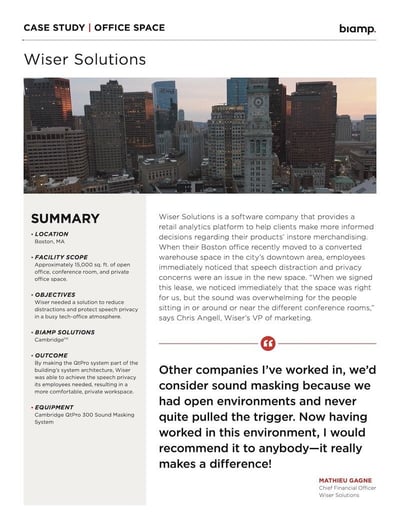
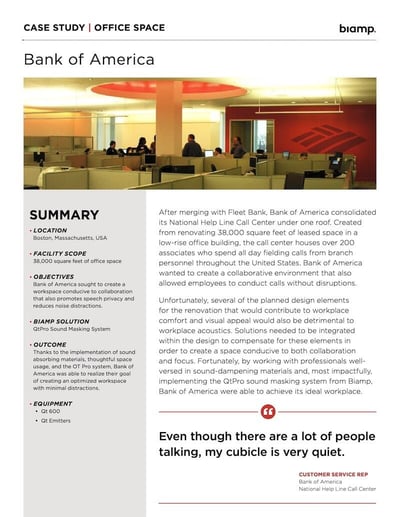
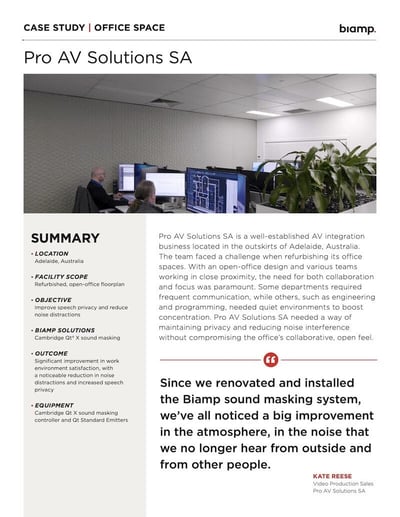
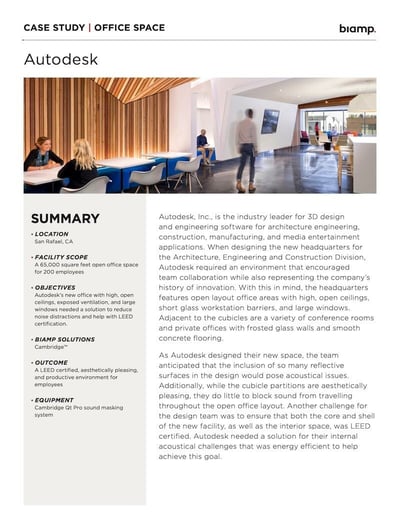
Trusted in workplaces like yours
How It Works
The technology at a glance
The “Right” Sound
Engineered to match speech frequencies, not generic white noise.
Shrinks the distraction radius
Hear speech less clearly. Understand less. Get distracted less.
Zoned & tunable
Different levels for open-plan, private offices and quiet rooms.
Sound masking is often referred to as “white noise”, however, unlike white noise, sound masking is specifically engineered to match the frequencies of human speech so the sounds emitted fade into the background “hum” of a workplace while simultaneously making speech more difficult to hear and understand.
Got Questions?
Frequently Asked Questions
Sound Masking is intentionally very low level and unobtrusive, typically in the range of 40–48 dBA which is similar to a quiet library or gentle airflow.
When properly tuned, it should blend into the background as a soft, consistent “hum” that most people stop noticing shortly after it is introduced.
No. Sound Masking is not noise cancelling. Noise cancelling works in small, localized applications like headphones, but is not practical for large commercial spaces.
Instead, Sound Masking works by adding a specially engineered background sound that makes conversations less intelligible at a distance.
Yes. Sound Masking can be designed for virtually any ceiling type, including exposed ceilings with their direct or indirect solutions.
No. While HVAC creates background noise, it is not engineered for speech privacy.
Sound Masking differs because it is precisely tuned to the frequency of human speech, while being evenly distributed across the space to maintain a comfortable, controlled sound level.
HVAC noise is typically uneven, inconsistent, and not optimised, so it does not provide the same privacy benefits.
No. Sound Masking does not reduce or remove loud noise sources.
Sound Masking reduces distractions from typical conversations and improves privacy in otherwise quiet or moderately noisy spaces.
Very loud noise (e.g., machinery or server rooms) will overpower masking sound, not the other way around.
No. Sound Masking does not absorb sound. To absorb sound, designers usually use materials like panels and carpets.
Sound Masking “covers” sound by adding specially engineered background sound that makes conversations less intelligible at a distance.
No. Sound Masking does not block sound transmission. Blocking requires physical barriers like walls or partitions, whereas Sound Masking instead makes speech harder to understand (less intelligible) through a low, inobtrusive background sound.
No. Sound masking is delivered a very low level and unobtrusive allowing for nearby conversations to remain clear and natural. Only distant conversations become less intelligible to reduce distractions from across the room.
Yes. Sound Masking plays an important role in protecting confidential conversations by making speech less intelligible to unintended listeners.
For environments where a higher level of security is required, Sound Masking can be combined with Eavesdropping Protection solutions. These systems are specifically designed to prevent intentional listening or interception of sensitive conversations, providing an additional layer of protection beyond standard masking.
This combined approach helps ensure that conversations remain private, whether preventing casual overhearing or protecting against deliberate eavesdropping.
Experience the power of privacy
A free, no-obligation demo: hear the difference in your own space.
Book My Free Demo2026 Biamp© Connecting people through extraordinary audiovisual experiences™
2026 Biamp© Connecting people through extraordinary audiovisual experiences™